
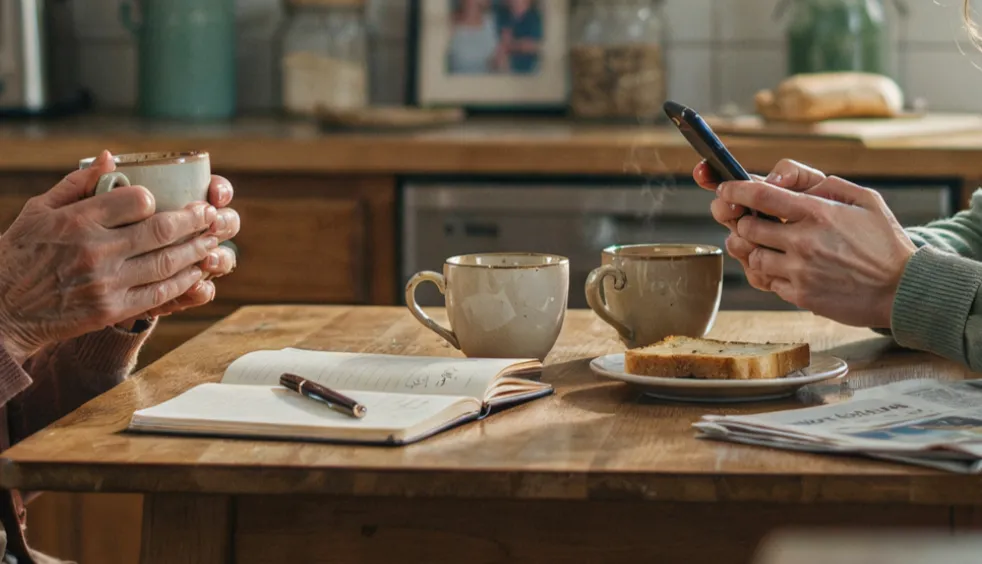
I thought I was researching “check-ins.” I think maybe I am actually researching dignity.
By Molly Townsend
Last week, I started interviewing people about how they stay connected with their loved ones. I’m building Kindred Journey this summer, and I’m focused on research right now. I’m primarily focused on adults who have parents that are living alone. I’ve been asking them to share their experiences, what worries them about their parents living alone, what routines they may or may not have, and any experiences they may want to share. I’ve found some really informative patterns amongst all my messy notes from these conversations.
I had no idea how much I’d learn before I sat down for my first conversation. Going into the week, I thought the problem was “how do families check in on a loved one?” but after many interviews, I think it’s something more deep: “how do families make sure their loved one is okay and still have that human connection without them feeling like they are being managed?” Nobody wants to feel like a burden to their family, which makes this a tricky problem to tackle. Here are a few things I’ve learned so far, and more on why I think it comes down to dignity:
The most useful check-ins usually don’t look like check-ins.
One woman I spoke with shared that she and her mom share their Wordle scores every morning. It started organically during the rise in popularity of Wordle, and now her mom jokes that if she doesn’t receive the Wordle from her, something may be wrong. And yet, she isn’t really joking. It has served as a dignified way to form connection without the inhumanity of a “system.”
Another person talked about a family group chat where they send random updates throughout the day. Politics, gas prices, grandkids, anything goes! It’s not designed to be a check-in system, but it does serve to form a connection. The seniors in this group chat seem to appreciate that their family knows they are doing okay, without having to say “I’m doing ok, today.”
The most common thing I’ve heard so far is that families are sending random life updates as an excuse to check in. I think both parties know it’s a check-in, but there seems to be some dignity in how it is being accomplished. I have heard so many great stories of how families are connecting, and yet many I’ve talked to are excited to hear that I’m pursuing a way to offer a product that helps with this connection.
A lot of people actually do have a system in place. They just don’t call it that.
I was a bit surprised to learn this. Whether it’s shared calendars, Life360, cameras, emergency buttons, neighbors, group chats, daily calls, Apple Notes, Wordle, or sibling messengers, most families do seem to have something in place. Some systems are basic and some are more involved. A few people have cameras in place since that is the only way they could find to truly know their parents are okay. This is more common, of course, with less active seniors who may not be truly independent.
Some folks talked about how they are using emergency buttons. Most seemed to find them unhelpful due to false alarms, forgetting to use it, or the indignity of something that is artificial and not a human connection. As I expected, the phone seems to be the most common technical solution, although it certainly isn’t failproof itself, and more than one person noted how easily a strange iPhone feature got activated and created confusion.
The clear pattern is that families are not doing nothing. In some cases, they are doing a lot. And continuing to try to stitch together a solution that is both reliable and acceptable to a prideful senior who aims to not be a chore for their family.
The scary part is the gray area.
A lot of angst that I heard from the adult children of seniors is that they don’t know what to do and how far to go when the system sends a signal. A missed text could just mean the senior is busy or away from their phone. Maybe they are at the grocery store, or maybe they just simply forgot to respond. The family doesn’t want to overreact, but of course, they are worried about underreacting if there is a problem. This seems to generate a cycle of emotional escalation that is at the core of the reason so many people were eager to talk to me. I think this is really what matters if I’m going to present a product to this market. The product must somehow solve for this gray area.
This isn’t just a “Build an easy-to-use app for the senior” problem.
Before I started talking to adult children, I was focusing a lot on the senior adult and their experience. How would they interact with a product, remember to use a product, or even like a product? This is certainly important to consider, but as I was talking with adult children, I realized that they are just as much of a user as their parents are. They’re the ones who often carry the anxiety but still try to respect their parent’s independence. So many of the folks that I talked with shared how they are raising kids, working, traveling, and are so busy all the time, and on top of that, they are trying to stay connected to their loved ones who, in some cases, live over an hour away. There is a whole emotional component that isn’t outwardly visible until I had these conversations.
One person compared caring for a parent to almost becoming the parent, while another brought up the sandwich generation problem, where one person might be caring for their kids and their parents at the same time.
Independence is a bigger deal than I realized.
In almost all of my conversations, we ended up talking about how many senior adults do not want help even if they need it. When I thought about it more, it makes perfect sense. No one wants to suddenly become the person everyone worries about. These adults have parented their kids their whole life, and they don’t want to feel like their child needs to parent them or even check in on them. I’m sure lots of research has been conducted in this area already, but for me, the chance to talk to real people with real challenges really helped me see how they struggle to balance staying connected without creating a loss of independence and dignity as their parents age. I heard about seniors who are still quite active: climbing ladders, driving, and doing repair work. Of course, this makes their family nervous. And yet, it seems core to personal values of independence. I’ve recognized that there is no magic product that will make this challenging family dynamic evaporate, but I think I’m hopeful I can find a way to offer a product that provides value without a loss of independence.
The product probably cannot be for every stage of aging.
I think this is perhaps the most important thing I’ve learned so far. There is a big difference across the spectrum of older adults who have family that want to check in on them. An active 72 year old who texts and drives and travels is quite different from an 86 year old with advanced dementia who cannot reliably use a phone. Never mind that there are 90 year olds still very active and folks in their 60s with advanced cognitive decline. There is no cookie-cutter analysis that can be done based on age or any other simple demographics. The full spectrum of needs is important, of course, but it may not be solved by a single product.
As of now, I think my product focus will be for families in the middle. The seniors are not completely independent and probably live alone, but they also definitely aren’t in need of professional care. This is where the real emotional struggles seem to first creep in. The children feel they need to check in a bit more than they have in the past, but they recognize the need to do it gently. Establishing a rhythm of connection that emits gentle signals in the event that the pattern is broken feels like the product focus I might start with.
I keep coming back to one potential guiding principle: make it feel like connection first and foremost.
The more I talk to real people, the less interested I am in building a cold, impersonal safety app. Those are already out there. And I’m not sure they address the need I’m focusing on. While the fear of something bad happening could be a great motivator for someone to try my product, I don’t think it’s the right focus. I think the motivator should be more along the lines of a desire to have stronger inter-generational connection. And, as a natural consequence, families will be at ease that they are more likely to know if and when something is wrong.
So, with a focus on connection and a strict goal of maintaining dignity, I tiptoe into the next phase of my journey: product design. I can’t help but wonder whether I’ve painted myself into a corner of solving an impossible problem. As my mentor is fond of saying, though: it’s not a real product unless it solves a real problem for a real person in the real world.